
WordPress fighting Ghosts and EmDashes
EmDash is the new content management system by Cloudflare, joining Ghost as another WordPress competitor. Both of them bring some important questions to everyone publishing content online.
The printing press revolutionised books; LiveJournal and WordPress revolutionised the way we publish online. When this blog began in 2006, it was powered by WordPress, which was also my path to learning how to develop websites, from the server to the frontend.
Today, WordPress is still close to the hearts and souls of bloggers, enthusiasts, plugin builders. It powers small business sites, and large media publications. It has a large ecosystem of developers, plugins, themes, and consultants and deserves all the credit for making it easier to publish online.
Now times are different. WordPress deals with some criticism regarding security and the way that the plugin marketplace works. It endured through the social media walled gardens of MySpace and Facebook. I believe that was thanks to the hard work of the Automattic team and the community of developers.
There are two new competitors in town, Ghost and EmDash.
Ghost was founded by John O'Nolan who comes from a background as Deputy Head of the WordPress UI Group. It is no wonder that it feels like a modernised version of the WordPress open-source software.
Now comes EmDash, "the spiritual successor to WordPress". It is built by CloudFlare, the company that sits between us and the websites we visit. I am biased towards CloudFlare, I use their services for myself and for clients, and everyone I met from there felt like a great person to be around.
 Matt “TK” Taylor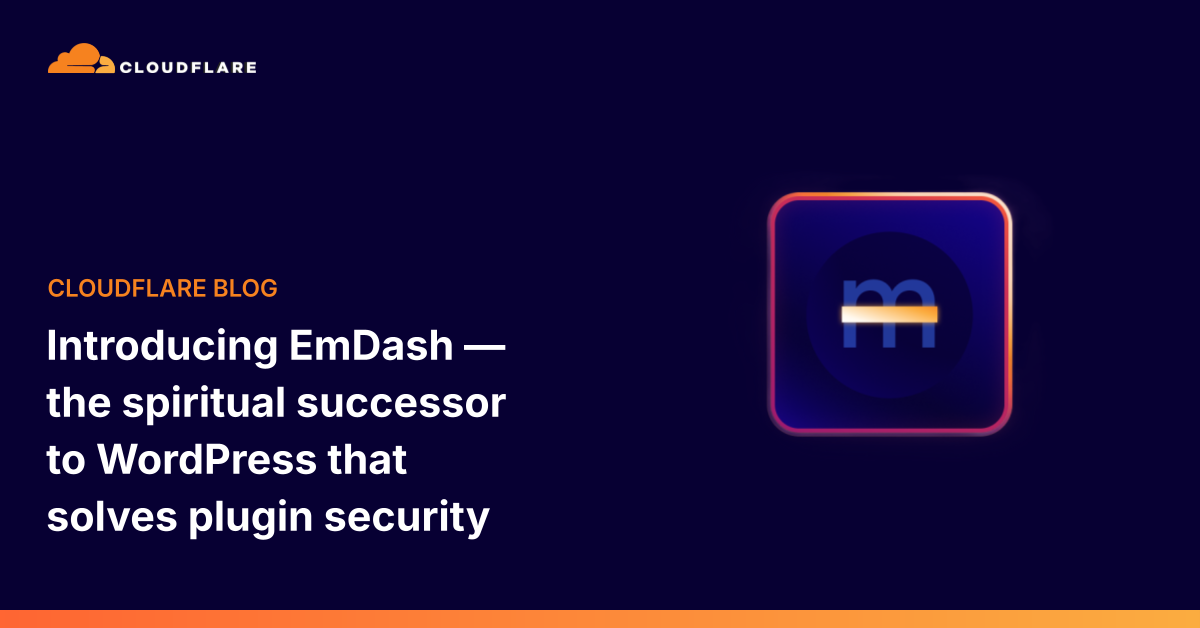
The first Ai-First content manager
I haven't started testing it, but read the announcement and there are some things worth pointing out.
- Features that integrate with AI tools and Agents;
- Option to charge for access to content by humans or AI agents;
- No server complexity;
Not all sites require a server like in the past. It is possible to host a full site on the CloudFlare network using their CloudFlare pages service. I have used them often for projects big and small. As an example, the AI-HED — Ai in Higher Education project is fully served by their service and has no difference from a regular website. And it's more secure from the start.
With EmDash, CloudFlare is luring more users to use their services. And this sounds great, until you realise that there isn't a place where all your content sits to be backed up, copied, or archived. Less complexity also means more vendor lock-in.
And content is precious to publishers of any size. It's not just the time it took you to write it, it's the way you, and others, can access it and use it.
When we realised that AI companies had used open content to train their Language Models, CloudFlare proposed charging AI Crawlers for access. With EmDash, they are laying the foundation so that both humans and AI Agents can pay for access to the site in a transparent way.
Imagine your website offers regular reports. EmDash allows you to sell access to those reports so that AI Agents could read them and act upon them. This may be a big twist for markets where gathering information is key.
And if your site is heavy in content, requiring a lot of manual labour to upload and update, EmDash has a solution too. It provides the context and the tools for AI tools to use it with minimal friction.
- Agent Skills: EmDash contains AI instructions for any AI agent to use it and configure it, making management tasks easier. Everything the agent needs to customize the site in the way we need. Less complexity, more cognitive debt for us.
- EmDash Command Line Interface: No need to open the web interface, an agent or programmed script can execute all sorts of tasks.
- Built-in MCP Server: Plug it in to Claude, ChatGPT, or any other, and you can talk your site into being what you need it to be.
What this means for online publishing
We need new ways to keep the open web alive
Right now we can say that this is just one more option popping up as an alternative to WordPress and we do not know if it will find its place in the big scheme of things.
But EmDash and Ghost are saying something very important: we need new ways to keep the open web alive that do not rely solely on ads and clickbait titles. Ghost suggests growing a community of free and paid subscribers; EmDash tackles the AI field, offering a way for Agents to interact fairly with the websites they visit.
I don't think they will dethrone the king, but they are nudging the web towards a new path and we have to pay attention.
What's in it for PR and Comms professionals
EmDash suits publishing teams that need to handle high volumes of content, or who have a strong requirement for high quality content. — Getting AI to revise and ask questions about what we are publishing is a good way to improve our output. Your newsrooms and crisis comms can get a productivity boost.
Ghost suits people and organisations focused on building a community around quality content. Research, data, expert commentary, they all benefit from a paid or gated model.
At the Lisbon Collective we are not taking sides. Our goal is to solve problems for clients and at the same time contribute to an open web. We will support WordPress, EmDash, and Ghost. They all bring valuable features and help us move away from the walled garden traps of social media companies.
As for me, I will be drinking my own poison and exploring what EmDash can bring for new projects I have been working on.



Comments ()